
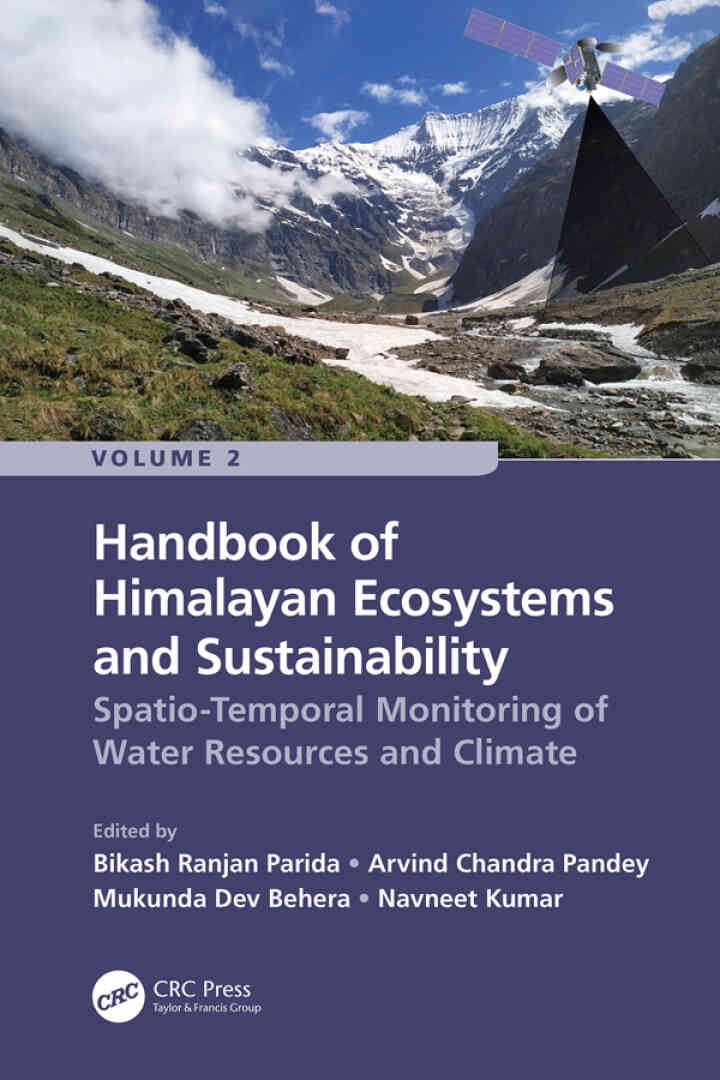
Handbook of Himalayan Ecosystems and Sustainability, Volume 2: Spatio-Temporal Monitoring of Water Resources and Climate, 1st Edition
$30.00
.Volume 2: Handbook of Spatio-Temporal Monitoring of Water Resources and Climate is aimed to describe the current state of knowledge and developments of geospatial technologies (Remote Sensing and Geographic Information Systems) for assessing and managing water resources under climate change. It is a collective achievement of renowned researchers and academicians working in the Hindu Kush Himalayan (HKH) mountain range. The HKH region is a part of the Third Pole outside the polar regions due to its largest permanent snow cover. Importantly, the Himalayan belt is geologically fragile and vulnerable to geohazards (e.g. landslides, land subsidence, rockfalls, debris flow, avalanches, and earthquakes). Therefore, critical assessment and geospatial solutions are indispensable to safeguard the natural resources and human beings in the Himalayas using space-borne satellite datasets. This book also showcases various remote sensing techniques and algorithms in the field of urban sprawling, urban microclimate and air pollution. The potential impacts of climate change on the cryosphere and water resources are also highlighted. This comprehensive Handbook is highly interdisciplinary and explains the role of geospatial technologies in studying the water resources of the Himalayas considering climate change. Key Features This book is unique as it focuses on the utility of satellite data for monitoring snow cover variability, snowmelt runoff, glacier lakes, avalanche susceptibility and flood modeling. Explain how Remote Sensing techniques are useful for mapping and managing the morphology and ecology of the Himalayan River. Addresses how geospatial technologies are valuable for understanding climate change impact on hydrological extremes, the potential impact of land use/land cover change (LULC) on hydrology and water resources management. It highlights the impact of LULC changes on land surface temperature, groundwater, and air pollution in urban areas. Includes contributions from global professionals working in the HKH region. Readership The Handbook serves as a valuable reference for students, researchers, scientists, Hydrologists, hydro-ecologists, meteorologists, geologists, decision makers and all others who wish to advance their knowledge on monitoring and managing water resources and urban ecosystem using remote sensing in the HKH region considering climate change.Handbook of Himalayan Ecosystems and Sustainability, Volume 2: Spatio-Temporal Monitoring of Water Resources and Climate 1st Edition is written by Bikash Ranjan Parida and published by CRC Press. ISBNs for Handbook of Himalayan Ecosystems and Sustainability, Volume 2 are 9781000784343, 1000784347 and the print ISBNs are 9781032203157, 1032203153. Additional ISBNs include 9781032207735, 9781003265160, 9781000784329.
Be the first to review “Handbook of Himalayan Ecosystems and Sustainability, Volume 2: Spatio-Temporal Monitoring of Water Resources and Climate, 1st Edition”
Related products

Best Seller zetlly pro

Best Seller zetlly pro
The Audiophile’s Project Sourcebook: 120 High-Performance Audio Electronics Projects

Best Seller zetlly pro

Best Seller zetlly pro
Handbook of Sound Studio Construction: Rooms for Recording and Listening

Best Seller zetlly pro
Designing, Building, and Testing Your Own Speaker System with Projects

Best Seller zetlly pro
Why Design Matters: Conversations with the World’s Most Creative People

Best Seller zetlly pro

Best Seller zetlly pro
Reviews
There are no reviews yet.