
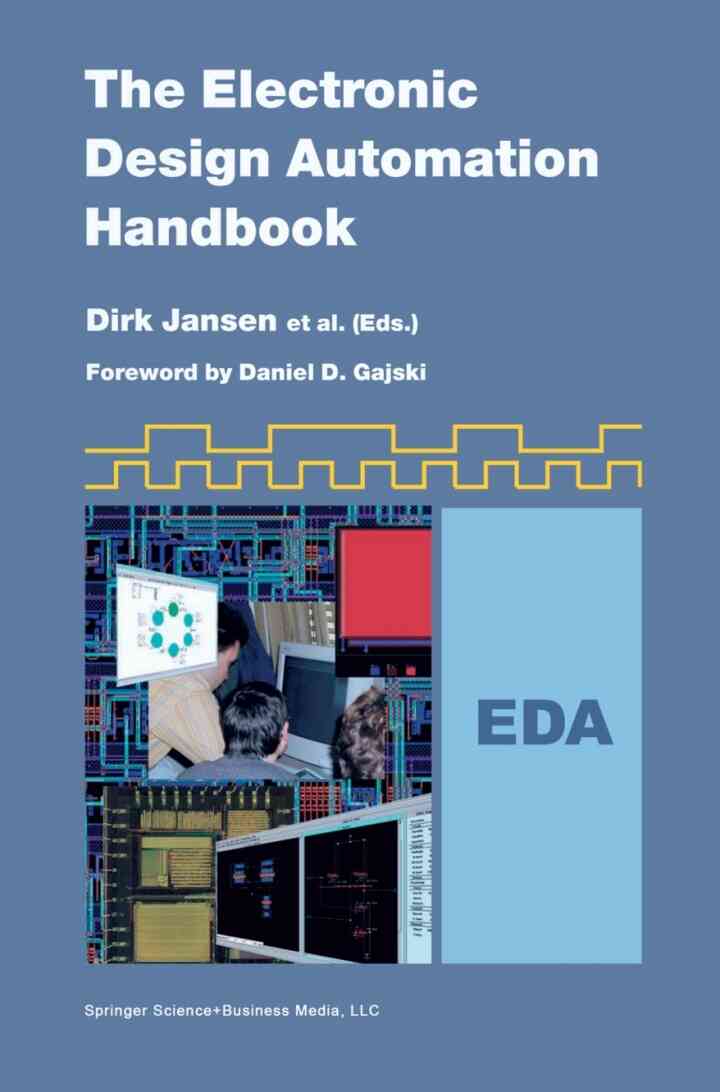
The Electronic Design Automation Handbook
$23.00
The Electronic Design Automation Handbook When I attended college we studied vacuum tubes in our junior year. At that time an average radio had?ve vacuum tubes and better ones even seven. Then transistors appeared in 1960s. A good radio was judged to be one with more thententransistors. Latergoodradioshad15-20transistors and after that everyone stopped counting transistors. Today modern processors runing personal computers have over 10milliontransistorsandmoremillionswillbeaddedevery year. The difference between 20 and 20M is in complexity, methodology and business models. Designs with 20 tr- sistors are easily generated by design engineers without any tools, whilst designs with 20M transistors can not be done by humans in reasonable time without the help of Prof. Dr. Gajski demonstrates the Y-chart automation. This difference in complexity introduced a paradigm shift which required sophisticated methods and tools, and introduced design automation into design practice. By the decomposition of the design process into many tasks and abstraction levels the methodology of designing chips or systems has also evolved. Similarly, the business model has changed from vertical integration, in which one company did all the tasks from product speci?cation to manufacturing, to globally distributed, client server production in which most of the design and manufacturing tasks are outsourced.Additional ISBNs9781441953698The Electronic Design Automation Handbook 1st Edition is written by Dirk Jansen and published by Springer. ISBNs for The Electronic Design Automation Handbook are 9780387735436, 0387735437 and the print ISBNs are 9781402075025, 1402075022. Additional ISBNs include 9781441953698.
Be the first to review “The Electronic Design Automation Handbook”
Related products


New Book




Reviews
There are no reviews yet.