
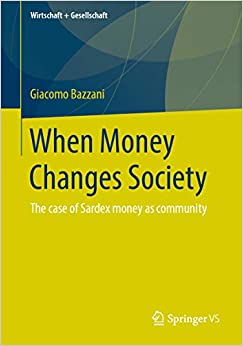
When Money Changes Society: The case of Sardex money as community (Wirtschaft + Gesellschaft)
$16.89
Classical sociology considered money as central to the functioning of modern society, relatingit to a progressive expansion of instrumental rationality and the emergence of weaker social ties.Modern money, the universal equivalent described by Simmel, facilitates theexchange of goods and values by providing a single unit of account. This “frees” people and thingsfrom traditional social ties and makes them free to “sell” their work and trade goods on markets thatincreasingly erode national borders. Modern money thus frees the individual from traditional socialties and facilitates the creation of ever larger and more inter-connected markets. Sardex money, onthe other hand, seems to work in the opposite direction: the weak social ties of ordinary economictransactions are replaced by strong ones, characterised by a high level of reciprocity and by an ethical code. Furthermore the movement of goods is restricted to the regional level and much isdone to promote economic exchanges between member companies.
Be the first to review “When Money Changes Society: The case of Sardex money as community (Wirtschaft + Gesellschaft)”
Related products

Ebook New zetlly
Russia, NATO and Cooperative Security: Bridging the Gap (Contemporary Security Studies)

Ebook New zetlly
Art Fundamentals Theory and Practice 12th dition by Otto Ocvirk
Ebook New zetlly
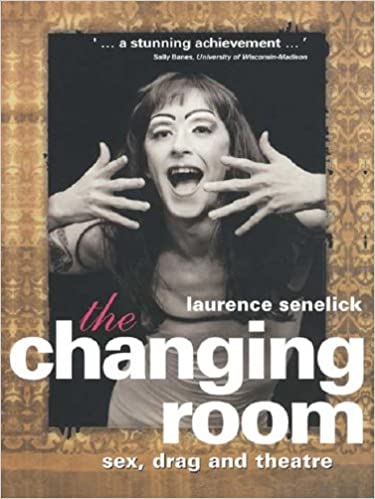
The Changing Room: Sex, Drag and Theatre (Gender in Performance)

Ebook New zetlly

Ebook New zetlly
Ebook New zetlly

Ebook New zetlly
Reviews
There are no reviews yet.